Random Post: This Week at Personal Genomes
RSS 2.0
  • Home
  • About
  • Aligners
  • Genomes
  • Subscribe
  • VarScan
  •  

    The Year of the Exome

    December 29th, 2010

    Next-generation sequencing technologies have dramatically altered the landscapes of genetics and genomics. There has been considerable interest in applying NGS platforms to selected regions of the human genome. Targeted sequencing of just the coding regions of the human genome — the exome — is of particular interest, because these regions presumably harbor the lion’s share of relevant genetic variation. In 2010, low-cost, high-throughput exome sequencing was made possible.

    Two companies emerged as the titans of exome capture for sequencing:

    • Nimblegen, whose SeqCap EZ Exome kit claims to yield >10x coverage for 90% of the exons from 18,000 genes.
    • Agilent, whose SureSelect All Exon kits target 40-50 megabases of CCDS exons.

    So which one is better? That’s a difficult question to answer, particularly because most groups with early access to these technologies are bound by non-disclosure agreements. Based on information in the public domain, such as the 20+ articles this year that employed exome sequencing, there is no clear winner. Some studies used Nimblegen, some used Agilent, and all of them achieved some kind of scientific success, or else we wouldn’t have read them. Clearly both of the companies are working hard to improve their products, and to incorporate the suggestions/requests of customers into their products. Both platforms saw a “version 2″ release this year with a larger target space and other improvements. At Personal Genomes I saw at least two posters for studies where 1,000 or more exomes would be (or have been) sequenced. One thing is clear: Agilent and Roche/Nimblegen are selling exome kits like crazy.

    Many fruits of exome sequencing have already come to market. A search for publications with ‘exome’ in the title turned up dozens of entries – two thirds of which were research articles on exome sequencing, and the other third, news briefs or reviews discussing its potential. A significant portion of these were low-hanging fruit: rare diseases of suspected genetic origin for which the causal gene(s) had not been identified. You can recognize these because they often have “syndrome” in the name: Fowler syndrome [13], Miller Syndrome [17], Kabuki syndrome [16], Sensenbrenner syndrome [7], Brown-Vialetto-van Laere syndrome [9] were all figured out (genetically) by exome sequencing this year. Mutations in a number of genes were linked to other rare inherited disorders:

    • WDR62 (severe brain malformations) [2]
    • GPSM2 (nonsyndromic hearing loss) [23]
    • STIM1 (fatal classic Kaposi sarcoma) [5]
    • ACAD9 (complex I deficiency) [8]
    • VCP (familial ALS) [10]
    • ADIPOQ (insulin resistance atherosclerosis) [4]
    • PIGV (hyperphosphatasia mental retardation) [12]
    • ANGPTL3 (familial combined hyperlipidemia) [15]
    • TGM6 (spinocerebellar ataxias) [24]
    • FADD (autoimmune lymphoproliferative syndrome) [3]

    You might think that given how rare these diseases are, the impact of such findings is not very significant. But to an investigator who’s spent his or her life studying a rare disease (or the family that has it), the possibility of finding the disease-causing gene in a single experiment is simply irresistible. Though the sample numbers are small, the ramifications of these discoveries are not. They enable everyone in the world with a rare disease, even if this only totals a handful of patients, to be efficiently genotyped for causal mutations. They shed light on new and unanticipated mechanisms of disease pathogenesis. They’ve even justified having CXXorfXX genes in the set of human genes (C20orf54 was shown to cause Brown-Vialetto-van Laere syndrome [9]).

    Larger studies of more common, more complex phenotypes are already beginning to pop up.  A collaboration between the University of Copenhagen (Denmark) and BGI (Shenzen) has sequenced the exomes of at least 250 individuals. A subset of these (n=50) were used to study adaptation to high altitude [26], while another 200 were the subject of a recent Nature Genetics paper [14] entitled “Resequencing of 200 human exomes identifies an excess of low-frequency non-synonymous coding variants,”  (whose inline title could have just been “Duh”).

    Thus, exome sequencing has already enabled significant advances in the understanding of [rare] human diseases. In the coming year, I expect we’ll see a dramatic scale-up as exome sequencing is applied to thousands of patients with cancer, diabetes, autism, and other common diseases. Who knows? Maybe 2011 will be the year of exome sequencing as well.

    References

    1. Bainbridge, M. N., M. Wang, et al. “Whole exome capture in solution with 3 Gbp of data.” Genome Biol 11(6): R62.
    2. Bilguvar, K., A. K. Ozturk, et al. “Whole-exome sequencing identifies recessive WDR62 mutations in severe brain malformations.” Nature 467(7312): 207-10.
    3. Bolze, A., M. Byun, et al. “Whole-exome-sequencing-based discovery of human FADD deficiency.” Am J Hum Genet 87(6): 873-81.
    4. Bowden, D. W., S. S. An, et al. “Molecular basis of a linkage peak: exome sequencing and family-based analysis identify a rare genetic variant in the ADIPOQ gene in the IRAS Family Study.” Hum Mol Genet 19(20): 4112-20.
    5. Byun, M., A. Abhyankar, et al. “Whole-exome sequencing-based discovery of STIM1 deficiency in a child with fatal classic Kaposi sarcoma.” J Exp Med 207(11): 2307-12.
    6. Cirulli, E. T., A. Singh, et al. “Screening the human exome: a comparison of whole genome and whole transcriptome sequencing.” Genome Biol 11(5): R57.
    7. Gilissen, C., H. H. Arts, et al. “Exome sequencing identifies WDR35 variants involved in Sensenbrenner syndrome.” Am J Hum Genet 87(3): 418-23.
    8. Haack, T. B., K. Danhauser, et al. “Exome sequencing identifies ACAD9 mutations as a cause of complex I deficiency.” Nat Genet 42(12): 1131-4.
    9. Johnson, J. O., J. R. Gibbs, et al. “Exome sequencing in Brown-Vialetto-van Laere syndrome.” Am J Hum Genet 87(4): 567-9; author reply 569-70.
    10. Johnson, J. O., J. Mandrioli, et al. “Exome sequencing reveals VCP mutations as a cause of familial ALS.” Neuron 68(5): 857-64.
    11. Kozlowski, P., M. de Mezer, et al. “Trinucleotide repeats in human genome and exome.” Nucleic Acids Res 38(12): 4027-39.
    12. Krawitz, P. M., M. R. Schweiger, et al. “Identity-by-descent filtering of exome sequence data identifies PIGV mutations in hyperphosphatasia mental retardation syndrome.” Nat Genet 42(10): 827-9.
    13. Lalonde, E., S. Albrecht, et al. “Unexpected allelic heterogeneity and spectrum of mutations in Fowler syndrome revealed by next-generation exome sequencing.” Hum Mutat 31(8): 918-23.
    14. Li, Y., N. Vinckenbosch, et al. “Resequencing of 200 human exomes identifies an excess of low-frequency non-synonymous coding variants.” Nat Genet 42(11): 969-72.
    15. Musunuru, K., J. P. Pirruccello, et al. “Exome sequencing, ANGPTL3 mutations, and familial combined hypolipidemia.” N Engl J Med 363(23): 2220-7.
    16. Ng, S. B., A. W. Bigham, et al. “Exome sequencing identifies MLL2 mutations as a cause of Kabuki syndrome.” Nat Genet 42(9): 790-3.
    17. Ng, S. B., K. J. Buckingham, et al. “Exome sequencing identifies the cause of a mendelian disorder.” Nat Genet 42(1): 30-5.
    18. Otto, E. A., T. W. Hurd, et al. “Candidate exome capture identifies mutation of SDCCAG8 as the cause of a retinal-renal ciliopathy.” Nat Genet 42(10): 840-50.
    19. Rosenfeld, J. A., A. K. Malhotra, et al. “Novel multi-nucleotide polymorphisms in the human genome characterized by whole genome and exome sequencing.” Nucleic Acids Res 38(18): 6102-11.
    20. Summerer, D., N. Schracke, et al. “Targeted high throughput sequencing of a cancer-related exome subset by specific sequence capture with a fully automated microarray platform.” Genomics 95(4): 241-6.
    21. Teer, J. K. and J. C. Mullikin “Exome sequencing: the sweet spot before whole genomes.” Hum Mol Genet 19(R2): R145-51.
    22. Tennessen, J. A., J. Madeoy, et al. “Signatures of positive selection apparent in a small sample of human exomes.” Genome Res 20(10): 1327-34.
    23. Walsh, T., H. Shahin, et al. “Whole exome sequencing and homozygosity mapping identify mutation in the cell polarity protein GPSM2 as the cause of nonsyndromic hearing loss DFNB82.” Am J Hum Genet 87(1): 90-4.
    24. Wang, J. L., X. Yang, et al. “TGM6 identified as a novel causative gene of spinocerebellar ataxias using exome sequencing.” Brain 133(Pt 12): 3510-8.
    25. Worthey, E. A., A. N. Mayer, et al. “Making a definitive diagnosis: Successful clinical application of whole exome sequencing in a child with intractable inflammatory bowel disease.” Genet Med.
    26. Yi, X., Y. Liang, et al. “Sequencing of 50 human exomes reveals adaptation to high altitude.” Science 329(5987): 75-8.
    27. Zhao, Q., E. F. Kirkness, et al. “Systematic detection of putative tumor suppressor genes through the combined use of exome and transcriptome sequencing.” Genome Biol 11(11): R114.
    AddThis Social Bookmark Button

    Mappability of the human genome

    December 9th, 2010

    Accurately mapping reads to a reference sequence is one of the most critical tasks for next-generation sequencing, yet it remains one of the most challenging areas of bioinformatics. Certainly, we’ve come a long way since ELAND and Maq. Dozens of new mapping and alignment algorithms have been published. Speed and sensitivity continue to improve; with BWA, we can map a lane of Illumina data (2×100 bp) to the human genome in about four hours. Nevertheless, it seems like most of the problems that arise in downstream analysis can be traced back to the read alignments.

    Mapping Error: Consequences and Causes

    Take variant calling, for example. The two central issues we try to address are false positives (variants that aren’t real) and false-negatives (real variants that are missed). Countless hours of manual review and extensive validation have shown that false positives rarely arise from simple sequencing errors. Such errors occur randomly, and with sufficient read depth (8x-10x), they can be readily ignored as background noise. Instead, most false positives are the result of an alignment errors – reads mapped to the wrong place, local mis-alignment around indels, etc. False-negatives are also a concern, particularly for indels. Why? Because the larger the gap between read and reference sequence, the more difficult it is to place correctly.

    In my humble opinion, three factors contribute to the problem of accurate read mapping: relatively short read lengths (36-100 bp), unprecedented throughput of NGS instruments, and size/complexity of the genome. As a bioinformatician, I can’t do much about the first two. The size and complexity of the genome, however, remains somewhat fixed. As such, many groups have sought to define those portions of the genome that are “mappable”, so that they can be prioritized for analysis.

    Quantifying Short Read Mappability

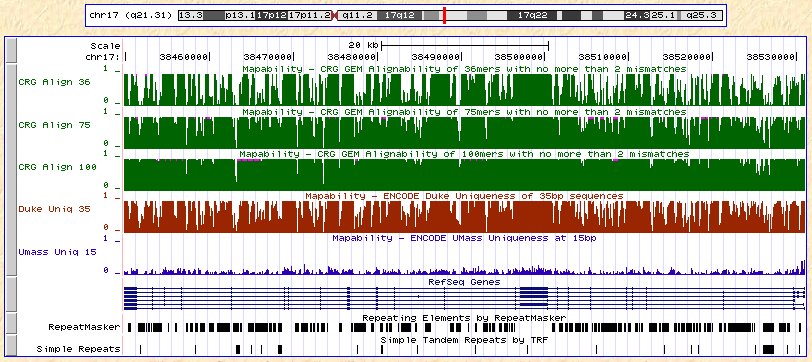
    Recently, I noticed that several such datasets have been incorporated as tracks in the UCSC Genome Browser. For build 18 (NCBI 36), there are about a dozen of them, all under the track name “Mapability”. Here are some of them across the BRCA1 gene region on chromosome 17:

    ucsc-mappability

    The top three tracks (in green) represent mappability with 36, 75, and 100bp reads as calculated by CRG-GEM, a suite of genome analysis tools by a group in Spain. Then there’s Duke uniqueness (35 bp) in red, and UMass uniqueness (15 bp) in blue. Looking at the tracks together, a few patterns become apparent: first, that mappability calculations remain fairly consistent across datasets generated by different groups. Most of the drops in mappability correspond nicely to RepeatMasker regions. Also, if the CRG results are accurate, the mappability increases substantially with read length (although the near-complete mappability for 100-mers seems a bit optimistic). This dovetails nicely with the theoretical expectation that longer reads can resolve more of the genome.

    Utilizing Genome-Wide Mappability Scores

    How might this information assist bioinformaticians with the analysis of NGS data? I have a few ideas. It could be used to normalize sequencing coverage by local mappability, for read-depth-sensitive measurements like genome-wide copy number. It can be plotted alongside whole-genome sequencing or capture coverage read depth, to help explain holes in coverage.

    It could even be used pre-emptively, for targeted sequencing projects, to assess the regions that will or will not have reads mapped. This sort of analysis is useful to set realistic expectations for collaborators, who might expect that, since they’ve heard so many nice things about next-gen sequencing, it will yield beautiful, even coverage across every single base they want. For time-sensitive projects, you could even adapt a sequencing strategy based on this information. On the Illumina platform, for example, a 36-bp fragment-end run finishes days before a paired-end run of longer reads. If one’s target regions were very mappable, and time was of the essence, a faster and less expensive sequencing run could be ordered.

    AddThis Social Bookmark Button

    Driver Mutations and Metastasis

    November 30th, 2010

    Two recent papers used very different appraoches to shed light on the genetic alterations underlying tumor growth and progression in human cancers. Peter Campbell and colleagues from the Wellcome Trust Sanger Institute employed Illumina paired-end sequencing to survey the landscape of structural variation in metastatic pancreatic cancer. Ivana Bozic and colleagues from Harvard University took a different approach – they constructed mathematical models of tumor progression via the accumulation of driver and passenger mutations. I happened to read both papers on a long airplane ride, and learned a great deal about mutations and metastasis in human cancers.

    Pancreatic Cancer: Bad News

    You learn a lot from the introduction sections of these papers, even if the Letter to Nature format keeps them short. I knew that pancreatic cancer had, in general, a poor prognosis. It turns out that the five year mortality for this cancer is 97-98%, usually due to “widespread metastatic disease.” These tumors also appear to carry a heavy mutational load. A 2008 survey of 24 pancreatic cancers (by Bert Vogelstein’s group at Johns Hopkins) found that tumors had ~63 genetic alterations on average, the majority of which were point mutations. Copy number changes are also common in this cancer type. Frequently mutated genes include tumor suppressors (TP53, SMAD4, CDKN2A) as well as oncogenes (KRAS, MYC). Less was known about the patterns of structural variation in pancreatic cancer.

    Detecting Rearrangements by Paired-End Sequencing

    Peter Campbell’s group has developed a very nice strategy for identifying somatically acquired rearrangments by massively parallel paired-end sequencing on the Illumina platform. They’ve already applied it to the characterization of SVs in several cancer cell lines. In this study, they generated 50-150 million read pairs (2 x 37 bp) per patient, which, in their experience, enables detection of 50-60% of rearrangements in a sample. Across the 13 pancreatic tumors, they identified 381 somatic and 177 germline rearrangements across seven categories: amplicon, deletion, tandem duplication, inversion, fold-back inversion, interchromosomal (translocation), and “other” intrachromosomal.

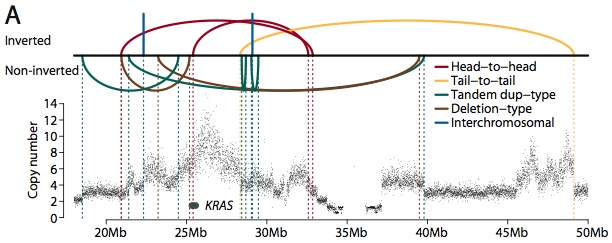
    Many rearrangements corresponded with a change in copy number. In one metastasis, for example, numerous rearrangements (some inverted, some not) combine to amplify the KRAS oncogene.

    Rearrangement/Amplification of KRAS (Credit: Nature).

    Rearrangement/Amplification of KRAS (Credit: Nature).

    Fold-back Inversions and Inter-Lesion Genetic Heterogeneity

    One sixth of the rearrangements identified fell into a class the authors call “fold-back” inversions. These are genomic regions that are duplicated, but the two copies face in opposite directions from the breakpoint (as opposed to a tandem duplication). The authors suggest breakage-fusion-bridge cycles as the likely mechanism that creates such an event. Basically, a double-stranded break that occurs during G0-G1 phase is replicated (in S phase), creating two duplicated end sequences. These are fused together by DNA repair processes, resulting in a sort of inverted duplication (fold-back inversion) with two centromeres. These “dicentric” chromosomes are unstable, and frequently initiate the amplification of oncogenes.

    Each rearrangement was [laboriously] genotyped by PCR in both the index tumor sample and matched normal control to verify the somatic status. Further, PCR and capillary sequencing were employed to resolve breakpoints, and some 206 rearrangements were genotyped across multiple lesions (metastases) in the 10 patients for which metastatic samples were available. There was a considerable amount of genetic heterogeneity among samples from the same patient. While the majority of rearrangements were present in all samples but not the germline (omnipresent); several were present in some samples but not others (partially shared) or unique to the index tumor sample (private).

    Telomere Loss and Breakpoint-Fusion-Bridge Cycles

    Fold-back inversions were significantly more likely than other classes of rearrangement to be omnipresent, suggesting that they occur early during tumor progression, before cancer cells disseminate. Because breakage-fusion-bridge cycles are often initiated by telomere loss, the activity of telomerase to maintain telomeres may play a pivotal role in the development of pancreatic cancer. Other studies have shown that telomerase expression is low in early tumor stages, but markedly increased in the invasive tumor. The increased expression likely suppresses breakage-fusion-bridge cycles, which may help explain why fold-back inversions are more likely to occur earlier in the development of the disease.

    Ongoing Evolution in Tumors and Mets

    In several patients, the authors found rearrangements that were in the primary tumor and some metastases, but not all of them. The most likely explanation for such a pattern is that the metastases were “seeded” by different cells from the primary tumor. This is intriguing, because it suggests ongoing clonal evolution, in the primary tumor, among cells capable of initiating metastases. There were also rearrangements in some metastases that weren’t detected in the primary tumor, suggesting that secondary lesions, too, are undergoing clonal evolution.

    Overall, the authors demonstrated that pancreatic cancers and secondary invasions show a substantial amount of genetic heterogeneity within the same patient. There’s certainly more to be done to get the full picture of genetic alterations in these tumors, but at just ~4-10 Gbp of data per sample, the scope and nature of what the authors have uncovered is pretty impressive.

    Drivers and Passengers

    The other paper (contributed by Bert Vogelstein to PNAS) took a theoretical approach to modeling the accumulation of driver and passenger mutations during tumor progression. In contrast to previous models that account for only 1-2 mutations, the authors develop a model in which mutations occur sequentially in tumor cells, with each new driver mutation conferring a slightly faster growth rate. This more closely reflects recently-characterized solid tumors, which harbor 40-100 coding gene alterations, of which 5-15 are considered “driver” mutations.

    Based on the assumption that any human cell contains 286 tumor suppressor genes and 91 oncogenes, the authors estimate that ~34,000 positions in the human genome could host a driver mutation. By this estimate, the driver mutation rate is approximately 3.4 x 10⁻⁵ per cell division. Under the authors’ assumption that each driver speeds tumor growth, the rate at which drivers accumulate becomes faster and faster, because the more drivers a cell has, the faster it divides. Not all mutations are successful, because they only reduce the probability that a cell will senesce or die (they don’t guarantee it). The authors considered a mutation in a tumor suppressor gene to be the central rate-limiting factor, since the other working copy tends to be lost relatively quickly due to large-scale LOH events.

    Six simulated patients were modeled and presented in this study. All of them started with one driver mutation. Strikingly, though all of the input values (mutation rate, division rate) were the same, there was enormous variation in the rates of tumor progression between simulated patients. Patient 1, for example, went 20 years before acquiring a second driver mutation, and the size of the tumor remained small (<5 g). In contrast, patient 6 had a secondary driver mutation in less than 5 years; by the end of the simulation, that tumor weighed hundreds of grams. While this model is undoubtedly an oversimplification, it does highlight the importance of, well, random chance. Given the large size of the human genome and the relatively small number of potential driver mutations, an individual’s fate hinges on stochastic processes. If you’re lucky, you go decades without picking up that crucial second hit. If you’re unlucky, you don’t.

    Intuitively, this seems reasonable, given the anecdotal evidence of de novo cancers, which seem to strike somewhat randomly. Of course, the older you are, the more times your cells divide, and the better chance you have of picking up additional driver mutations. And environmental exposures (like smoking and radiation exposure) certainly have a role to play, because they increase cellular mutation rates. Even so, if you believe in the model, chance plays a significant role.

    Here’s to hoping you’re one of the lucky ones.

    References

    Bozic I, Antal T, Ohtsuki H, Carter H, Kim D, Chen S, Karchin R, Kinzler KW, Vogelstein B, & Nowak MA (2010). Accumulation of driver and passenger mutations during tumor progression. Proceedings of the National Academy of Sciences of the United States of America, 107 (43), 18545-50 PMID: 20876136

    Campbell PJ, Yachida S, Mudie LJ, Stephens PJ, Pleasance ED, Stebbings LA, Morsberger LA, Latimer C, McLaren S, Lin ML, McBride DJ, Varela I, Nik-Zainal SA, Leroy C, Jia M, Menzies A, Butler AP, Teague JW, Griffin CA, Burton J, Swerdlow H, Quail MA, Stratton MR, Iacobuzio-Donahue C, & Futreal PA (2010). The patterns and dynamics of genomic instability in metastatic pancreatic cancer. Nature, 467 (7319), 1109-13 PMID: 20981101

    AddThis Social Bookmark Button

    Genetics and Epigenetics of Leukemia

    November 10th, 2010

    A study online at the New England Journal of Medicine reports that DNMT3A mutations in acute myeloid leukemia are common and associated with poor outcome for intermediate-risk patients. Previously, our group had characterized the genomes of two patients with cytogenetically normal AML (AML1 and AML2). The first genome (AML1) was initially sequenced with Illumina short reads (1×36 bp), revealing eight novel acquired (somatic) mutations but none that were recurrent. The second genome, AML2, harbored a recurrent mutation in the isocitrate dehydrogenase 1 gene (IDH1), which had recently been implicated in glioblastoma. Subsequent work has demonstrated that mutations in IDH1 and related gene IDH2 highly recurrent in AMLs with intermediate risk karyotypes (20-30% frequency).

    Resequencing the Relapse with Current NGS Technology

    For this study, we resequenced relapse tumor from patient AML1 using current Illumina technology (2×100 bp paired-end reads), achieving higher diploid coverage and enabling the identification of several novel nonsynonymous mutations. One of these was a 1-bp deletion in the DNA methyltransferase gene DNMT3A predicted to cause a frameshift resulting in a truncated protein.

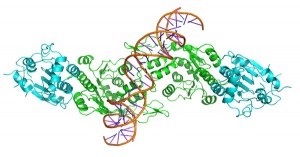
    dnm3a-dnmt3l-dna
    DNMT3A/DNMT3A Complex with DNA

    Resequencing showed that it was present in the original tumor sample, and probably missed due to alignment difficulties for short reads. Screening the exons of DNMT3A in 281 additional AML tumors revealed that 61 (22.1%) also had DNMT3A mutations with translational consequences. The most common of these was a missense mutation at residue 882, found in 37 tumors.

    Mutation, Methylation, and Disease

    When we realized how common this mutation was, and considered that the gene involved is a DNA methyltransferase, I have to admit that a tantalizing picture emerged. In my mind, at least. Mutation could lead to aberrant methylation of the tumor genome. Demethylation unmasks oncogene expression. Hyper-methylation leads to genome-wide instability, causing more mutations that activate oncogenes and disable tumor suppressors. DNA methylation has long been suspected in cancer, but the relationship between mutation, methylation, and disease progression has not been definitively established. At last, it seemed like we would bridge that gap.

    We performed a number of experiments to determine if DNMT3A mutation status affected mutation rate, genome-wide methylation, or gene expression.  First, we examined the 38 AML tumors that had undergone whole-genome sequencing (WGS) to ~25x coverage. Eleven of these carried DNMT3A mutations. There was no apparent correlation, however, between DNMT3A mutation status and the number of high-confidence mutations called genome-wide. Next, we assessed gene expression in 188 AML tumors and matched (normal) controls on microarrays. DNMT3A was expressed in all 188 tumors and matched normals, regardless of mutation status. Unsupervised clustering of gene expression patterns did reveal distinct clusters, but none correlated with DNMT3A status. We further performed targeted cDNA resequencing in tumors with mutations, and confirmed expression of most mutant alleles at the expected 50% frequency (though some were not seen in any cDNA, probably due to nonsense-mediated decay).

    So no effect on mutation, and no changes in gene expression. Hold your breath, and let’s look at methylation. MeDIP assays revealed 182 regions that were differentially methylated between DNMT3A-mutated and non-mutated tumors. All were hypomethylated in the mutated samples. But there was no consistent effect on the expression of nearby genes. And, sadly, there was no global effect of DNMT3A mutaiton on DNA methylation. We were 0 for 3. Last but not least, we turned to the clinical data.

    Clinical Correlation: DNMT3A and Prognosis

    When we stratified AML patients by risk (based on cytogenetics) and DNMT3A mutation status, some interesting patterns emerged. First, DNMT3A mutations were completely absent from the favorable-prognosis group. Mutations were enriched, however, among patients classified as “intermediate risk” – normal or unclear karyotypes. And the outcome for DNMT3A-mutated patients was significantly poorer. The adverse-outcome association was independent of age, although older patients with DNMT3A had the worst outcomes of any group. And the association held true regardless of the presence of other commonly-mutated AML genes (NPM1, FLT3, IDH1/IDH2). Thus, DNMT3A mutation clearly contributes to AML pathogenesis, even if the mechanism by which it does so remains elusive. The fact that DNMT3A mutations are selected against in favorable-outcome patients suggests a true biological association.

    A lot of work remains to be done. We still need to uncover the mechanistic effect of DNMT3A mutations that underlies the pathogenesis. But this work has furthered our understanding of AML, by identifying a highly recurrently mutated gene and providing a marker to help stratify patients of intermediate risk. As highlighted in a perspective by Shannon and Armstrong, clinical trials of DNA methlytransferase inhibitors in AML are already under way. It may not be long before genomic discoveries are translated into actionable information for the treatment of cancer patients.

    Related Articles

    Researchers discovery key mutation in acute myeloid leukemia (NIH News)

    Mutations in single gene predict poor outcomes in adult leukemia (WashU Record)

    References
    Ley, T., Ding, L., Walter, M., McLellan, M., Lamprecht, T., Larson, D., Kandoth, C., Payton, J., Baty, J., Welch, J., Harris, C., Lichti, C., Townsend, R., Fulton, R., Dooling, D., Koboldt, D., Schmidt, H., Zhang, Q., Osborne, J., Lin, L., O’Laughlin, M., McMichael, J., Delehaunty, K., McGrath, S., Fulton, L., Magrini, V., Vickery, T., Hundal, J., Cook, L., Conyers, J., Swift, G., Reed, J., Alldredge, P., Wylie, T., Walker, J., Kalicki, J., Watson, M., Heath, S., Shannon, W., Varghese, N., Nagarajan, R., Westervelt, P., Tomasson, M., Link, D., Graubert, T., DiPersio, J., Mardis, E., & Wilson, R. (2010). DNMT3A Mutations in Acute Myeloid Leukemia
    New England Journal of Medicine DOI: 10.1056/NEJMoa1005143

    Shannon, K., & Armstrong, S. (2010). Genetics, Epigenetics, and Leukemia New England Journal of Medicine DOI: 10.1056/NEJMe1012071

    AddThis Social Bookmark Button