RSS 2.0
  • Home
  • About
  • Aligners
  • Genomes
  • Subscribe
  • VarScan
  •  

    Emerging Hallmarks of Cancer

    September 12th, 2011

    In 2000, Hanahan and Weinberg published a landmark article in which they described the “hallmarks of cancer” – six biological capabilities acquired during the multi-step development of human tumors. It went on to become the most-cited Cell article of all time. In a follow-up article this year, the authors revisit their conceptual framework for cancer biology, incorporating the remarkable progress in cancer research that was made over the last decade.

    The authors conclude that their six hallmarks – sustained proliferative signaling, evading growth suppression, resisting cell death, replicative immortality, induction of angiogenesis, and invasion/metastasis – continue to provide a useful conceptual framework for understanding the biology of cancer. Further, they present two new hallmarks – reprogramming of energy metabolism and evasion of immune destruction – that have emerged as critical capabilities of cancer cells.

    I like to think that these new additions were perhaps inspired by two articles on Massgenomics earlier this year – Cancer versus the Metabolism (1/11/2011) and Cancer versus the Immune System (1/21/2011) – which I posted a couple of months before the new Cell paper. Clearly, these two concepts are drawing substantial attention from researchers and clinicians. Hanahan and Weinberg also elaborate on two “enabling characteristics” – properties of neoplastic cells that facilitate acquisition of hallmark capabilities. These include genome instability/mutation, which they discussed previously, and tumor-promoting inflammation, mediated by immune system cells that are recruited to the site of a developing tumor.
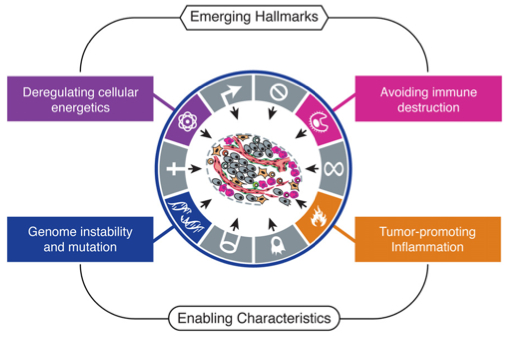
    Credit: Hanahan and Weinberg, Cell, 2011


    The Metabolic Switch: Aerobic Glycolysis in Cancer Cells

    It was Otto Warburg who first observed that cancer cells seem to favor glycolysis as a metabolic program over mitochondrial oxidative phosphorylation. This preference is normal in oxygen-poor environments. However, Warburg observed that tumors prefer glycolysis even in the presence of oxygen (aerobic glycolysis). This “metabolic switch” seems counter-intuitive, as the efficiency of glycolysis is 18-fold lower that oxidative phosphorylation. Cancer cells compensate for this, at least in part, by up-regulating glucose receptors (GLUT1) to import more glucose into the cytoplasm. Indeed, increased uptake and utilization of glucose has been reported for many human tumors.

    The functional rationale for this metabolic switch has not yet been elucidated. Preferential glycolysis has been associated with activated oncogenes and loss of tumor suppressors, both of which confer other hallmark capabilities on cancer cells. One possible explanation for the switch is that it enables diversion of glycolytic intermediates into other pathways, such as those responsible for synthesizing amino acids, nucleosides, and macromolecules. You know, the things necessary for making new cancer cells.

    Intriguingly, some tumors have two subpopulations of cells with different energy metabolism programs. One subpopulation exhibits the Warburg effect, favoring glycolysis and generating lactate along with those useful intermediates. The other subpopulation preferentially imports lactate, using it as the main energy source by harnessing part of the citric acid cycle. This apparently symbiotic relationship within tumors has provocative implications for the study and treatment of human cancers. It’s particularly because components of the citric acid cycle, specifically isocitrate dehydrogenases 1 and 2 (IDH1 and IDH2) have recently emerged as oncogenes that are recurrently mutated in gliomas and leukemias.

    Immunoevasion: Avoiding Immune Destruction

    In recent years, a substantial body of evidence from clinical epidemiology and mouse models has revealed that the immune system presents a significant barrier to tumor formation and progression. In immunodeficient mice, for example, carcinogen-induced tumors develop more often and progress more rapidly than in wildtype mice. Further, depleting either NK cells or T-cells in mice led to increased tumor incidence, suggesting that both innate and adapative immunity contribute to immune surveillance.

    Another important aspect of the relationship between immunity and cancer is the concept of “immunoediting”. In mouse models, carcinogen-induced tumors that arise in immunodeficient mice, when transplanted to wild-type mice, are usually eliminated by the intact immune system of the new host. In contrast, tumors induced in wild-type mice often grow when transplanted to other wild-type mice. Presumably, tumors induced in immunodeficient mice are highly immunogenic, and therefore easily identified and removed by a healthy immune system. However, tumors induced in wild-type mice have arisen despite an intact immune system. The selective pressure of the competent immune system “edits” the tumor by selecting for cells that can avoid immune destruction. Thus, by the time they are macroscopic, these tumors are poorly immunogenic, and more resistant to immune-mediated destruction.

    Inflammation as an Enabling Characteristic

    For years, pathologists have observed that most tumors are infiltrated by host immune cells, presumably ones that are attempting to destroy them. However, we now know that tumors actively recruit certain cells to aid in their growth and progression. Specifically, inflammatory cells of the innate immune system have been shown definitively to have tumor-promoting activity. In healthy tissues, inflammation serves a number of critical functions – fighting infections, wound healing, repair of damaged tissue and cells. To accomplish these duties, inflammatory cells produce an array of biochemicals that can benefit tumor growth, notably growth factors, survival factors, and matrix-modification enzymes. Furthermore, inflammatory cells can release mutagenic chemicals, such as reactive oxygen species, that increase the mutation rates in tumor cells, further accelerating their evolution towards more aggressive growth.

    Additional evidence supporting the tumor-promoting role of inflammation is the observation that individuals with chronic inflammation are more susceptible to cancers at the site of that inflammation – e.g. patients with Crohn’s disease show increased incidence of colorectal cancer. Indeed, it is now evident that inflammation is present even at the very early stages of some tumors, and capable of promoting their development into full-blown cancer.

    The Next Decade

    The ten years since Hanahan and Weinberg’s seminal article have seen remarkable progress in cancer research. Notably, the six hallmarks of cancer were further supported and refined, was was the enabling characteristic of genome instability. Two new emerging principles (reprogramming cellular energetics and avoiding immune destruction) became evident, as did a second enabling characteristic (inflammation). There’s a lot more in the current review that I didn’t touch on, such as the tumor-promoting activities of non-tumor cells (e.g. fibroblasts, pericytes) and the importance of cancer stem cells (CSCs).

    In coming years, thousands of tumors will be characterized by ever-more high-throughput technologies, such as massively parallel sequencing. Collecting the data is no longer the obstacle; instead, the true challenges lie in analysis and interpretation. Hanahan and Weinberg humbly describe their hallmarks as “organizing principles” for thinking about why cancer cells do what they do. Conceivably, fitting new catalogues of genetic alterations to this model of acquired capabilities will help us better understand the relationship between genotype (genetic susceptibility and somatic mutation) and phenotype (tumor development, growth, and metastasis).

    References

    Hanahan D, & Weinberg RA (2011). Hallmarks of cancer: the next generation. Cell, 144 (5), 646-74 PMID: 21376230
     

    AddThis Social Bookmark Button

    NOTCH tumor suppression in HNSCC

    August 9th, 2011

    More than half a million new cases of head and neck squamous cell carcinoma (HNSCC) will occur in 2011, making it the 6th most common malignancy in the world. Two studies online at the journal Science survey the mutational landscape of this deadly cancer, which has a mortality rate of ~50%. They report frequent mutation of the NOTCH1 gene in HNSCC (11-15% of cases), and the patterns of these mutations suggest a tumor suppressive role. This observation is in stark contrast with many solid tumors and hematopoietic malignancies where Notch signaling is thought to play an oncogenic role. Moreover, it carries worrisome implications for Notch1 inhibitors, some of which have recently entered clinical trials.

    HNSCC Pathology

    Around 50,000 cases of HNSCC are diagnosed each year in the United States. The genomes of HNSCC bear many chromosomal aberrations, including amplifications targeting the CCND1 gene on chr11q13, and the epidermal growth factor receptor gene (EGFR) on chr7p11. Many of these tumors also exhibit genetic or epigenetic alterations of TP53 and CDKN2A, two well-known tumor suppressor genes. Tobacco and alcohol exposure are risk factors. More recently, HPV infection has emerged as a risk factor as well. Patients with HPV-associated tumors have a better chance of survival, indicating distinct biological features for this form of the disease.

    Exome Sequencing of HNSCC

    Stransky et al performed solution-phase capture and Illumina sequencing of 74 tumor-normal pairs, achieving 150-fold average depth of target regions and covering 87% of bases with at least 20 reads. They also performed SNP array-based copy number analyses. Common CCND1 amplifications, CDKN2A deletions, and rarer amplifications of MYC, EGFR, ERBB2, and CCNE1 suggested that their tumor set was genetically representative of HNSCC. Using exome data, the authors predicted ~130 coding mutations per tumor, of which 25% were synonymous changes.

    Agrawal et al examined 32 tumor-normal exome pairs: 17 by Illumina sequencing, and 15 by SOLiD sequencing. They achieved 77-fold (Illumina) and 44-fold (SOLiD) average depth of target regions, with 90-92.6% of target bases covered by at least 10 reads. Most of the tumors (30 of 32) came from pre-treatment patients, and all were selected for >60% tumor cellularity. This latter selection was an important one, as the Stransky et al study had sequenced but not reported 18 additional tumor-normal pairs due to extensive stromal admixture.

    HPV, TP53, and Tobacco Exposure

    Taken together, both studies found that HPV-associated HNSCC truly represents a distinct disease at the molecular level, with a lower mutation rate (2.28 per megabase compared to 4.83 per megabase) than HPV-negative tumors. Further, none of the HPV-associated tumors carried TP53 mutations, whereas the gene was mutated in 62-78% of HPV-negative tumors. Only 18% of HPV-negative tumors had mutations in bona fide oncogenes, which is not good news for the prospect of targeted therapies. Mutation rates in smokers were higher than those of non-smokers. While Agrawal et al reported no evidence of tobacco exposure in their study, this might have been due to the limited sample size (32 tumors), because Stransky et al (with 74 tumors) observed an excess of G to T transversions at non-CpG islands, consistent with carcionogen-induced mutations.

    Inactivating Mutations in Notch

    Both studies made an interesting observation: an excess of mutations in the NOTCH1 gene, many of which were protein-truncating alterations. Further, several tumors had lost both copies of NOTCH1, either by mutation or large-scale deletion. These observations suggest that NOTCH1 is being inactivated in HNSCC. In contrast, the Notch signaling pathway is up-regulated in numerous human cancers, particularly hematopoietic tumors. The newly-established tumor suppressive role of NOTCH has important implications for cancer therapies, as several NOTCH pathway inhibitors have entered clinical trials. One of these trials was recently halted, partly because of treatment-associated skin cancers.

    A number of other genes related to squamous cell differentiation proved to be mutated at significant frequencies, including NOTCH2, IRF6, TP64, RIPK4, CDH1, EZH2, Dicer1, and MLL2. Other mutations affected genes involved in calcium-sensing (RIMS2 and PLCO) or apoptosis (CASP8, DDX3X). These gene sets, and the NOTCH-related genes in particular, suggest an important role for normal squamous cell developmental pathways in the formation of squamous cell carcinoma.

    References
    Stransky N, Egloff AM, Tward AD, Kostic AD, Cibulskis K, Sivachenko A, Kryukov GV, Lawrence M, Sougnez C, McKenna A, Shefler E, Ramos AH, Stojanov P, Carter SL, Voet D, Cortés ML, Auclair D, Berger MF, Saksena G, Guiducci C, Onofrio R, Parkin M, Romkes M, Weissfeld JL, Seethala RR, Wang L, Rangel-Escareño C, Fernandez-Lopez JC, Hidalgo-Miranda A, Melendez-Zajgla J, Winckler W, Ardlie K, Gabriel SB, Meyerson M, Lander ES, Getz G, Golub TR, Garraway LA, & Grandis JR (2011). The Mutational Landscape of Head and Neck Squamous Cell Carcinoma. Science (New York, N.Y.) PMID: 21798893

    Agrawal N, Frederick MJ, Pickering CR, Bettegowda C, Chang K, Li RJ, Fakhry C, Xie TX, Zhang J, Wang J, Zhang N, El-Naggar AK, Jasser SA, Weinstein JN, Treviño L, Drummond JA, Muzny DM, Wu Y, Wood LD, Hruban RH, Westra WH, Koch WM, Califano JA, Gibbs RA, Sidransky D, Vogelstein B, Velculescu VE, Papadopoulos N, Wheeler DA, Kinzler KW, & Myers JN (2011). Exome Sequencing of Head and Neck Squamous Cell Carcinoma Reveals Inactivating Mutations in NOTCH1. Science (New York, N.Y.) PMID: 21798897

    AddThis Social Bookmark Button

    Genome Atlas of Ovarian Cancer

    July 29th, 2011

    Ovarian cancer (OVC) is the fifth leading cause of cancer death among women in the United States, with 21,880 new cases diagnosed annually. This is a particularly deadly cancer, in part because it often goes undetected until it has spread to much of the peritoneal cavity. Indeed, 70% of the estimated 13,850 deaths attributed to ovarian cancer last year were of patients presenting with advanced-stage, high-grade serous ovarian carcinoma. The standard treatment is aggressive surgery followed by platinating chemotherapy; in 31% of patients, chemo-resistant tumors recur within six months. The overall five-year survival is 31%. In short, new treatments are desperately needed.

    Two important studies shed new light on the genetic alterations driving ovarian cancer. In Nature, The Cancer Genome Atlas Research Network has published its integrated analysis of ovarian carcinoma.  In PNAS, a group led by researchers at Dana-Farber Cancer Institute performed systematic loss-of-function studies in cell lines of ovarian and other cancers.

    TCGA employed an arsenal of high-throughput technologies to systematically catalogue molecular aberrations in nearly 500 OVC cases:

    • DNA copy number, assessed by high-density CGH and SNP arrays (489 cases)
    • mRNA and miRNA expression, profiled on Affymetrix and Agilent arrays (489 cases)
    • Promoter methylation, assessed on Illumina array (519 cases)
    • Coding mutations, assessed by whole-exome sequencing on Illumina (236 cases) and ABI SOLiD (80 cases).

    Altogether, these datasets enabled integrated copy-number/expression/methylation analyses of 489 cases and integrated copy-number/expression/methylation/mutation analyses in 316 cases.

    Mutations in Ovarian Carcinoma

    Exome sequencing targeted ~180,000 exons from ~18,500 genes totaling ~33 Mbp of non-redundant sequence, of which 76% were sufficiently covered for mutation detection (on average). A total of 19,356 mutations were catalogued, which works out to around 61 per tumor. Consistent with previous reports, the TP53 gene was mutated in almost all tumors (96%), while germline BRCA1 and BRCA2 mutations were present in 9% and 8% of cases, respectively. Some six additional genes were found to have statistically significant rates of mutation:

    Gene NCBI ID Ensembl ID Description
    CSMD3 114788 ENSG00000164796 CUB and Sushi multiple domains 3
    NF1 4763 ENSG00000196712 neurofibromin 1
    RB1 5925 ENSG00000139687 retinoblastoma 1
    GABRA6 2559 ENSG00000145863 gamma-aminobutyric acid (GABA) A receptor, alpha 6
    FAT3 120114 ENSG00000165323 FAT tumor suppressor homolog 3 (Drosophila)
    CRKRS 51755 ENSG00000167258 Cdc2-related kinase, arginine/serine-rich (CDK12)

    Some of these hits are unsurprising; NF1 and RB1 both encode well-known tumor suppressors. CRKRS, also known as CDK12, is an interesting novel hit; it encodes a cyclin-dependent kinase required for RNA splicing. Deletions on chromosome 17 in gastric cancer often produce rearrangements involving CDK12 and ERBB2. Comparisons of the TCGA-OV mutation dataset to COSMIC and OMIM databases yielded 477 and 201 matches, respectively, including mutations in well-known cancer genes BRAF, PIK3CA, KRAS, and NRAS.

    Gene Expression Subtypes

    There were ~1,500 intrinsically variable genes in HGS-OV cases, which clustered robustly into four expression subtypes:

    • Immunoreactive, characterized by T-cell cytokine ligands (CXCL10, CXCL11) and a receptor (CXCR3).
    • Proliferative, which showed high expression of transcription factors (HMGA2, SOX11) and proliferation markers (MCM2, PCNA)
    • Differentiated, associated with expression of ovarian tumor markers MUC16 and MUC1.
    • Mesenchymal, marked by high expression of HOX genes and stromal component markers.

    Survival duration did not vary significantly between expression subtypes. There were some notable correlations with copy number events: MECOM amplification was more frequent in the immunoreactive subtype, while MYC and RB1 alterations were less common in the proliferative subtype. The former observation may have some therapeutic implications, as MECOM was one of a handful of amplified genes that are targeted by at least one drug compound.

    DNA Methylation Patterns

    DNA methylation was correlated with reduced gene expression across all samples. The promoters of three genes in particular (AMT, CCL21, and SPARCL1) were hyper-methylated (silenced) in most tumors. As previously reported, the BRCA1 promoter was epigenetically silenced in >10% of tumors. One surprising finding was that RAB25, which has been reported to be over-expressed in ovarian carcinomas, was epigenetically silenced in a subset of tumors.

    Copy Number Alterations

    GISTIC analysis of copy number data for 489 cases identified 63 regions of focal amplification. Three such amplifications (CCNE1, MYC, and MECOM) were present in at least 20% of cases. New tightly localized amplification peaks in ovarian cancer encoded the receptor for activated C-kinase (ZMYND8), a p53 target gene (IRF2BP2), a telomerase catalytic subunit (TERT), and, notably, an embryonic development gene (PAX8) that featured in the PNAS study. There were also 50 focal deletions; among these were known tumor-suppressor genes PTEN, RB1, and NF1.

    Investigation of Genetic Vulnerabilities

    Cheung and colleagues took a complementary approach. To identify genes essential for tumor proliferation and survival, they performed systematic RNAi screens of 11,194 genes in 102 cancer cell lines. Each cell line was infected in quadruplicate with a pool of lentivirus-delivered short hairpin RNA, and then assessed for the effect on proliferation.A weight-of-evidence statistic served to evaluate and rank the “essentiality” of each gene in each cell line.

    BRAF and KRAS mutations, unsurprisingly, were ranked highly in cell lines harboring those mutations. Theirs was a striking effect, such that the top-scoring shRNAs for KRAS and BRAF easily distinguished cell lines that were mutated (mutant) or not (wild-type) for those genes. In PIK3CA-harboring cell lines, MTOR shRNAs scored highly, and could distinguish between PIK3CA-mutated and PIK3CA-wildtype tumors. This observation supports prior work that mTOR plays a role in PI3K signaling.

    Tumor Lineage-Specific Dependencies

    Next, the authors assessed all shRNAs for their ability to distinguish one specific tumor lineage (tumor type and cell type) from all others. Here, they build on recent work establishing that oncogenic transcription factors are often amplified, over-expressed, and essential in subsets of tumors from specific lineages (e.g. NKX2-1 in lung adenocarcinoma, MITF in melanoma, and SOX2 in squamous cell carcinoma). Therefore, the authors searched not only for shRNAs that distinguished specific lineages, but also those that were amplified or over-expressed in that tumor type.

    • In colon cancer cell lines, KRAS, CTNNB1, and BRAFwere scored as essential, and KRAS and IGF1R were both essential and amplified. MYB and AXIN2 were scored as essential and also differentially expressed.
    • In pancreatic cancer cell lines, KRAS stood out as essential, and SOX9 emerged as a lineage-specific dependency.
    • In NSC lung cancer cell lines, NKX2-1 was essential, amplified, and over-expressed. There were seven genes essential and amplified, including CDK6. Interestingly, MAP2K4, an activator of JNK and p38, showed selective essentiality and expression.

    Deeper Analysis of Ovarian Cancer

    The authors next leveraged information from TCGA’s ovarian cancer study for a deeper analysis of gene essentiality. Among the 1,825 genes in amplified regions reported by TCGA, some 50 were deemed essential in the ovarian cancer cell lines. They included the known oncogene CCNE1, along with adaptor protein FRS2, RPTOR, and the PRKCE protein kinase.

    One gene, PAX8, hit the trifecta. It was amplified in 16% of primary ovarian tumors. It was over-expressed in 21 of 25 ovarian cancer cell lines, and scored as “essential” by all three scoring methods the authors used. Further, when ovarian cancer cell lines were compared to other cell lines, PAX8 was the most-differentially-expressed gene. Suppression of PAX8 but had no effect on the proliferation of immortalized ovarian surface epithelial cells or 8 other cell lines that did not express PAX8. However, it induced apoptosis and reduced viability by  >50% in 6/8 ovarian cell lines. Three of these had PAX8 amplifications, and the other three had PAX8 over-expression.

    PAX8 encodes a lineage-specific transcription factor involved in the development of the thyroid, kidney, and female reproductive tract. In the latter, its expression is restricted to secretory cells of the fallopian tube epithelium, which (according to recent reports) is a point of origin for serous ovarian carcinoma. Previous studies have also shown that PAX8 is amplified in ovarian cancer; immunohistochemistry suggests that it is expressed in 90-100% of serous, clear-cell, and endometrioid subtypes.

    Tumor Genomes and Genetic Vulnerabilities

    I think that the TCGA study is important because it demonstrates the discovery power of integrated analysis – mutation, gene expression, copy number, and methylation combined. When all of these data types are put together, a comprehensive picture of the tumor emerges – the landscape of its genomic alterations and epigenetic changes, and the ensuing differential gene expression.

    Combined with systematic functional studies, this atlas of ovarian cancer became even more powerful. A systematic and fairly unbiased analysis of genes essential for the tumor’s survival, reinforced with genomic data, yielded a possible weak point common to most cancers of that type, and offering a valuable starting point for new therapeutic approaches.


    AddThis Social Bookmark Button

    Recurrent mutations in chronic lymphocytic leukemia

    June 10th, 2011

    A study published online at Nature reports the identification of three recurrently mutated genes by whole-genome sequencing of four cases with chronic lymphocytic leukemia (CLL). This is the most common adult leukemia in western nations, with two major subtypes distinguished by somatic hypermutation of the immunoglobulin heavy chain (IgH) variable region. Led by Xose S. Puente of Universidad de Oviedo in Spain, the authors applied a combination of whole-genome sequencing, exome sequencing, and long-insert library sequencing to tumor samples and matched (normal) controls from two patients of each subtype.

    Puente et al identified roughly 1,000 somatic mutation per tumor in unique regions, estimating a mutation rate of less than one per 1 megabase. This is consistent with other leukemias, although (to my disappointment) the authors failed to refer to the first two sequenced leukemia genomes, AML1 (Ley et al, Nature 2008) and AML2 (Mardis et al, NEJM 2009), which I’ve cited below. In these four CLL cases, the most common substitution was G>A / C>T, which usually occurred in a CpG context. Interestingly, the mutation spectrum differed between subtypes; IGHV-mutated cases showed a higher fraction of A>C / T>G substitutions, and often A>C mutations occurred at adenines preceded by a thymine. The context and patterns of mutations in IGHV-mutated cases was consistent with error-prone polymerase during the normal process of somatic hypermutation of IGHV genes.

    Somatic Coding Mutations

    The authors divided somatic mutations into one of three classes:

    1. Class 1 mutations, which include nonsynonymous substitutions and frameshift indels
    2. Class 2 mutations, which include synonymous and UTR substitutions
    3. Class 3 mutations, comprising everything else.

    This classification system is similar to my group’s approach, which we apply separately to SNVs and indels. We classify variants as “tier 1″ if they affect coding sequences, “tier 2″ if they affect conserved bases or known regulatory elements, “tier 3″ if they map to unique noncoding regions, or “tier 4″ otherwise. For the present study, however, I dug into supplementary information to build this summary table of somatic coding mutations:

    Category CLL1 CLL2 CLL3 CLL4
    Frameshift (indels) 1 2 2 0
    Nonsynonymous/Splice 9 18 9 5
    Synonymouse (silent) 3 5 2 3
    Total Coding 13 25 13 8

    Summarized in the above fashion, these mutation counts are similar to the number observed in AML1 (n=10) and AML2 (n=12). The relatively small number of somatic coding mutations in leukemia is just incredible.

    Recurrent Mutations in CLL

    Using a pooled sequencing strategy, Puente et al screened for mutations in 26 genes among 169 additional CLL cases. The rate of recurrence is reported for 363 CLL patients; it was unclear how the ~200 additional cases were examined. In any event, four genes proved to harbor recurrent mutations in CLL:

    • NOTCH1 (12% of cases), a key signaling molecule involved in developmental processes that controls cell fate decisions. The observed mutations generate a truncated protein lacking the PEST sequence, which was constitutively activated and more stable than the wild-type isoform. NOTCH1-mutated patients had more advanced CLL at presentation.
    • MYD88 (2.9% of cases), an effector molecule for IL1 and TLR receptor signaling. In mutated cells, activation of IL-1 or TLR signaling triggered a dramatic over-production of IL1RA, IL6, CCL2, CCL3, and CCL4. The high production of these cytokines is known to recruit macrophages and T-lymphocytes, creating a favorable micro-environment for tumor survival. Indeed, patients with MYD88 mutations were diagnosed at a younger age, and with more advanced tumors.
    • XPO1 (1.1% of cases), which encodes exportin 1, a protein implicated in the nuclear export of proteins and mRNAs (including MAP kinases). Notably, all four cases with this mutation were of the IGHV-unmutated subtype and had NOTCH1 mutations, indicating a possible synergistic effect between mutated NOTCH1 and XPO1.
    • KLHL6 (0.8% of cases), which plays a role in germinal center formation during B-cell maturation. The three mutated cases harbored multiple point mutations, consistent with somatic hypermutation.

    Based on functional and clinical analyses, the authors conclude that mutations in NOTCH1, MYD88, and XPO1 are oncogenic changes that contribute to the clinical evolution of CLL.

    Structural Alterations

    Using paired-end sequence data and a basic analytical approach, the authors identified ten somatic structural variants (SVs), most of which were known events in CLL. Three of four cases harbored a deletion of 13q14; the minimally-deleted region includes several genes and a couple of micro-RNAs. This is a known lesion in CLL, and was not pursued further in the main text. From the copy number data in Figure 1, it is clear that these CLL genomes harbor relatively few genomic rearrangements, which is again consistent with what we’ve seen for acute leukemia.

    Variant Detection Sensitivity and Specificity

    The authors mention that they employed not just WGS but exome sequencing, though the latter finds no place in the main text. Looking through the supplemental materials, I found that some 42 mutations were identified and validated by exome sequencing. Of these, 37 were found using WGS data, suggesting a sensitivity of ~88% for somatic coding mutations. All mutations were manually reviewed to remove common sequencing- and alignment-related artifacts. Some validation was performed using PCR and Sanger sequencing; among the 86 class 1 / class 2 variants for which PCR and Sanger sequence data were obtained, 83 proved to be valid somatic mutations. An additional 384 random mutations (96 per tumor) underwent validation as well, and 96% of these were validated. This is an impressive specificity, though I would attribute it to the manual review process, which may not scale to genomes with more than 10-20 somatic mutations.

    References

    Puente XS, Pinyol M, Quesada V, Conde L, Ordóñez GR, Villamor N, Escaramis G, Jares P, Beà S, González-Díaz M, Bassaganyas L, Baumann T, Juan M, López-Guerra M, Colomer D, Tubío JM, López C, Navarro A, Tornador C, Aymerich M, Rozman M, Hernández JM, Puente DA, Freije JM, Velasco G, Gutiérrez-Fernández A, Costa D, Carrió A, Guijarro S, Enjuanes A, Hernández L, Yagüe J, Nicolás P, Romeo-Casabona CM, Himmelbauer H, Castillo E, Dohm JC, de Sanjosé S, Piris MA, de Alava E, Miguel JS, Royo R, Gelpí JL, Torrents D, Orozco M, Pisano DG, Valencia A, Guigó R, Bayés M, Heath S, Gut M, Klatt P, Marshall J, Raine K, Stebbings LA, Futreal PA, Stratton MR, Campbell PJ, Gut I, López-Guillermo A, Estivill X, Montserrat E, López-Otín C, & Campo E (2011). Whole-genome sequencing identifies recurrent mutations in chronic lymphocytic leukaemia. Nature PMID: 21642962

    Mardis, E., Ding, L., Dooling, D., Larson, D., McLellan, M., Chen, K., Koboldt, D., Fulton, R., Delehaunty, K., McGrath, S., Fulton, L., Locke, D., Magrini, V., Abbott, R., Vickery, T., Reed, J., Robinson, J., Wylie, T., Smith, S., Carmichael, L., Eldred, J., Harris, C., Walker, J., Peck, J., Du, F., Dukes, A., Sanderson, G., Brummett, A., Clark, E., McMichael, J., Meyer, R., Schindler, J., Pohl, C., Wallis, J., Shi, X., Lin, L., Schmidt, H., Tang, Y., Haipek, C., Wiechert, M., Ivy, J., Kalicki, J., Elliott, G., Ries, R., Payton, J., Westervelt, P., Tomasson, M., Watson, M., Baty, J., Heath, S., Shannon, W., Nagarajan, R., Link, D., Walter, M., Graubert, T., DiPersio, J., Wilson, R., & Ley, T. (2009). Recurring Mutations Found by Sequencing an Acute Myeloid Leukemia Genome New England Journal of Medicine, 361 (11), 1058-1066 DOI: 10.1056/NEJMoa0903840

    Ley TJ, Mardis ER, Ding L, Fulton B, McLellan MD, Chen K, Dooling D, Dunford-Shore BH, McGrath S, Hickenbotham M, Cook L, Abbott R, Larson DE, Koboldt DC, Pohl C, Smith S, Hawkins A, Abbott S, Locke D, Hillier LW, Miner T, Fulton L, Magrini V, Wylie T, Glasscock J, Conyers J, Sander N, Shi X, Osborne JR, Minx P, Gordon D, Chinwalla A, Zhao Y, Ries RE, Payton JE, Westervelt P, Tomasson MH, Watson M, Baty J, Ivanovich J, Heath S, Shannon WD, Nagarajan R, Walter MJ, Link DC, Graubert TA, DiPersio JF, & Wilson RK (2008). DNA sequencing of a cytogenetically normal acute myeloid leukaemia genome. Nature, 456 (7218), 66-72 PMID: 18987736

    AddThis Social Bookmark Button